Why Stone Dust Fails Under Pavers (And What the ICPI Actually Recommends)

Need Exact Math for Your Project?
Launch our free online tool: Sand Calculator & Estimator
Why Stone Dust Fails Under Pavers (And What the ICPI Actually Recommends) — Assembly Anatomy
Interactive 3D Isometric Engineering Rig • Verified Model
Your contractor said stone dust. Maybe he called it "crusher fines" or "quarry screenings." He said it packs hard, it's cheap, and he's been using it for twenty years. Here's why that's a $3,000 mistake — and here's what the Interlocking Concrete Pavement Institute actually says you should use instead.
I've torn up dozens of patios and walkways that were bedded on stone dust. Every single one showed the same pattern: beautiful for the first summer, slightly uneven by fall, and a lumpy, rutted mess after the first hard winter. The homeowner always asks the same question — "What went wrong? We spent so much on the pavers." The pavers were fine. The paver base sand wasn't paver base sand at all. It was stone dust, and stone dust doesn't belong under pavers.
Before you buy a single bag of material, run your project through our Sand Calculator to figure out how much proper C33 sand you actually need. Getting the right material and the right quantity saves you from doing this job twice.
TL;DR
- Stone dust has too many ultra-fine particles (15–30%+ passing the No. 200 sieve) that trap water.
- Trapped water → freeze-thaw cycles → heaving → shifting pavers → ruts and gaps.
- The ICPI explicitly warns against using stone dust as bedding material.
- Use ASTM C33 concrete sand as your paver base sand — it drains properly and stays stable.
- Fixing a stone dust base means full removal and replacement. There's no shortcut.
What Is Stone Dust and Why Do Contractors Use It?
Stone dust is the fine residue left over from crushing rock at quarries. It's typically composed of particles smaller than 3/16 inch (4.75 mm), with a heavy concentration of material finer than 0.075 mm — the stuff that passes through a No. 200 sieve. It's also called quarry screenings, crusher fines, or rock dust depending on your region.
Contractors reach for it because:
- It's cheap. Often $15–$25 per ton versus $30–$50 for washed C33 concrete sand.
- It compacts extremely hard. Freshly compacted stone dust feels rock-solid, which gives everyone false confidence.
- Habit. Many contractors learned to use it 20 or 30 years ago, before the ICPI published clear guidance against it. Old habits are the hardest ones to break.
- Availability. Any quarry that processes crushed stone has mountains of the stuff. It's a byproduct they're happy to move.
That hard-packed feeling is actually part of the problem. Stone dust compacts too well initially because all those fine particles wedge together and block void space. That eliminates drainage. And without drainage, everything downstream in the failure chain gets triggered.
The Science of Failure — How Stone Dust Traps Water
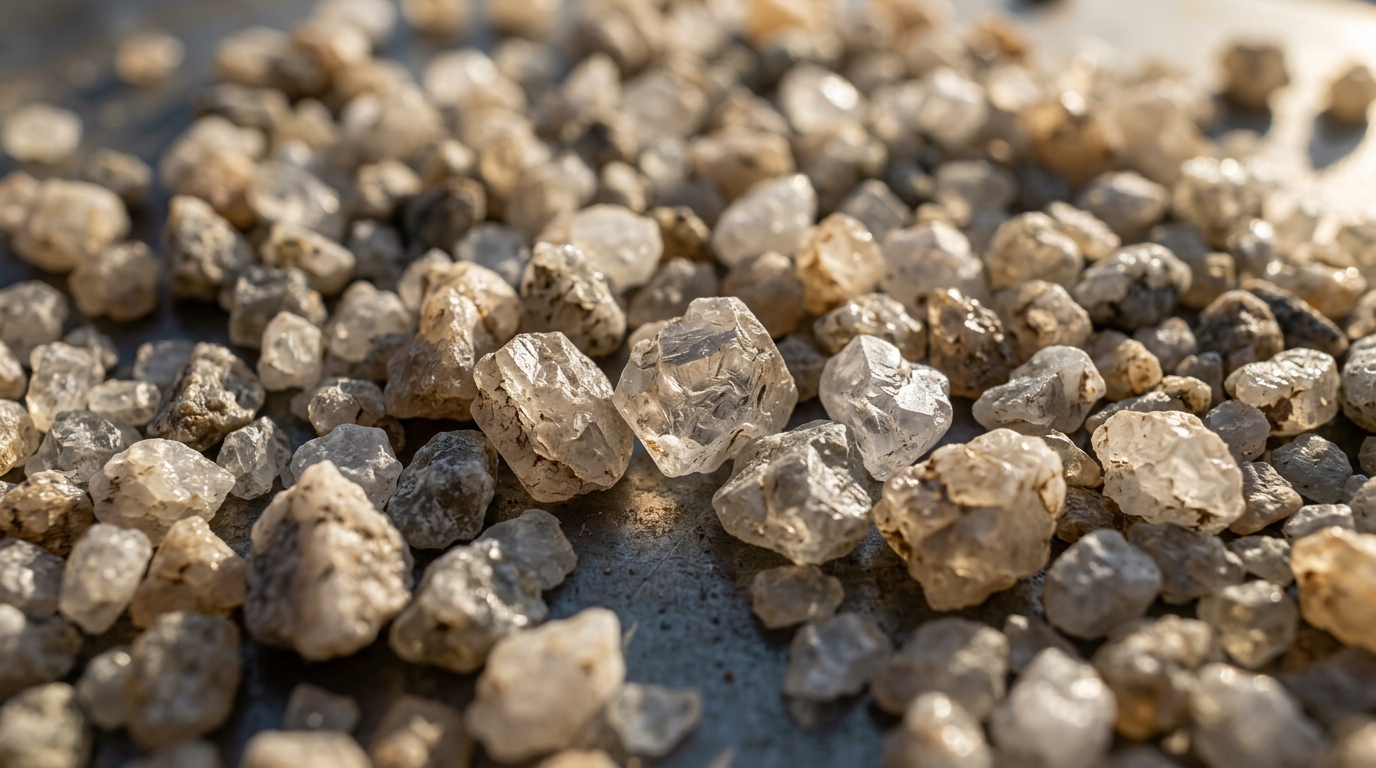
Here's what happens underground when you use stone dust instead of proper paver base sand:
The ultra-fine particles in stone dust — that 15–30% passing the No. 200 sieve — fill the voids between larger particles almost completely. In well-graded ASTM C33 concrete sand for pavers, those voids are intentionally left partially open so water can flow through. In stone dust, they're sealed shut.
When rain hits the paver surface, water seeps through the joints and reaches the bedding layer. In a proper C33 bed, it drains straight down into the gravel base and away. In stone dust, it pools. The fine particles act like clay — they hold moisture through capillary action and surface tension. The bedding layer becomes saturated.
Now winter arrives.
That saturated stone dust freezes. Water expands roughly 9% when it turns to ice. The expanding ice pushes pavers upward — but not uniformly. Some areas freeze before others. Some have more moisture than others. The result is differential heaving: some pavers rise a quarter inch, others rise a half inch, and your once-flat patio looks like a miniature mountain range.
When spring comes, the ice melts. But the pavers don't settle back to where they were. The melting leaves voids — pockets where ice used to be. Pavers drop into those voids at random. You get ruts, lips, and gaps between pavers. Those gaps invite ants, weed seeds, and even more water infiltration, which accelerates the next freeze-thaw cycle.
It's a self-reinforcing loop. Every winter makes it worse.
ASTM C33 Concrete Sand — The ICPI-Approved Alternative

The fix isn't complicated: use the material the industry's own governing body recommends. The ICPI's Tech Spec 2 for interlocking concrete pavement specifies ASTM C33 concrete sand for the bedding layer — and explicitly warns against stone dust, crusher fines, and screenings.
Why does C33 work where stone dust doesn't?
- Controlled fines content. ASTM C33 limits material passing the No. 200 sieve to roughly 3–5%. That's a fraction of stone dust's 15–30%+. Fewer fines means open void space for drainage.
- Angular particle shape. Like stone dust, C33 sand is crushed (not rounded). Those angular faces interlock under compaction and resist lateral shifting. You get the stability without sacrificing drainage.
- Predictable gradation. The sieve analysis for C33 ensures a consistent blend of particle sizes. This gives you uniform compaction and uniform drainage across the entire bedding layer — no surprise wet spots or soft zones.
Stone Dust vs. ASTM C33 Concrete Sand: Head-to-Head
| Property | Stone Dust | C33 Concrete Sand |
|---|---|---|
| Fines (< 0.075 mm) | 15–30%+ | 3–5% |
| Drainage Rate | Poor — water pools | Excellent — drains freely |
| Compaction Stability (Dry) | High | High |
| Compaction Stability (Wet) | Fails — becomes unstable | Maintains structure |
| Frost Heave Risk | High | Low |
| ICPI Approved for Bedding | ❌ No | ✅ Yes |
| Typical Cost (per ton) | $15–$25 | $30–$50 |
| Ant/Weed Resistance | Poor (gaps form) | Good (stays tight) |
That cost difference — maybe $15–$25 extra per ton — is where the "savings" argument for stone dust falls apart. One ton of C33 costs a few bucks more. Tearing up and relaying a patio costs $2,000–$5,000. I've never had a customer tell me the $40 they saved on sand was worth the $3,000 repair.
For a full breakdown of concrete sand specs, grading, and sourcing, read the complete guide: concrete sand for pavers. And for ASTM C33 certification details and what to look for on a spec sheet, see bedding sand for pavers: the ASTM C33 guide.
Real Paver Failures I've Seen from Stone Dust
I'm not speaking hypothetically here. These are jobs I've been called in to fix.
1. The Sinking Walkway (First Winter)
A homeowner in a northern climate had a 4-foot-wide, 40-foot-long walkway installed in September. Stone dust bedding, 2 inches thick (already too deep — ICPI says 1 inch, but that's a separate issue). By January, the walkway had developed a noticeable dip near the middle where roof runoff pooled. By March, three sections had heaved so badly that the lips between pavers were a tripping hazard. The stone dust had turned into a sopping, grainy paste underneath. We pulled every paver, excavated 2 inches of stone dust slurry, re-compacted the gravel base, and screeded 1 inch of C33 paver base sand. Three years later, still flat.
2. The Pooling Patio with Moss
A 400-square-foot patio in a shaded backyard. Proper slope was built into the gravel base — 1/8 inch per foot, draining away from the house. But the stone dust bedding layer held water like a bathtub. The patio surface stayed damp for days after rain. Within two seasons, moss was growing in every joint. The pavers themselves were green and slippery. The homeowner thought it was a grading problem. It wasn't — it was a bedding sand problem. The water wasn't draining through the bedding layer even though the slope was correct. Swapping the stone dust for C33 concrete sand for pavers fixed the drainage and the moss dried out within weeks.
3. The Ant-Infested Paver Joints
This one surprised even me. A front entry patio — small, maybe 120 square feet — started developing ant mounds between pavers within one year. The stone dust base had settled unevenly, opening gaps at the paver joints. Ants moved in and started mining the fine stone dust particles, carrying them to the surface and creating those telltale little sand volcanoes. The more they mined, the more the bedding layer eroded, the more the pavers shifted, and the wider the gaps became. It was a feedback loop. We replaced the stone dust with C33, re-set the pavers, and filled the joints with polymeric sand. Ant problem solved. Paver leveling sand done right means tight joints and no invitation for insects.
How to Fix a Failed Stone Dust Base
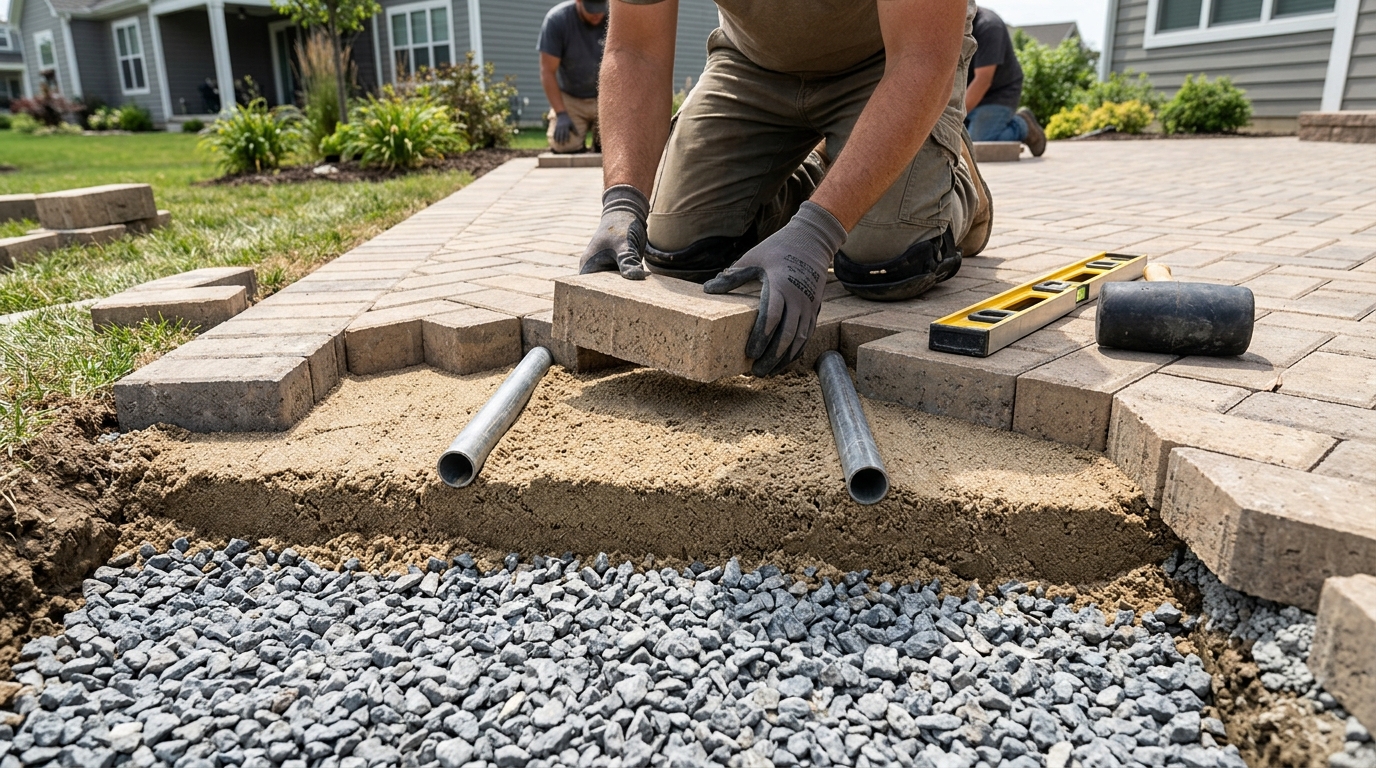
If you've already got stone dust under your pavers and you're seeing the signs — heaving, rutting, pooling, shifting — there's no patch that'll fix it. You have to replace the bedding layer. Here's the process:
- Remove all pavers carefully. Pop them up with a flat pry bar or screwdriver. Stack them on edge in groups. If they're in good shape, you'll reuse them.
- Remove all edge restraints. You'll reinstall them after re-bedding.
- Excavate the stone dust completely. Shovel and scrape it down to the compacted gravel base. Don't leave a residue — stone dust fines mixed into your new C33 bed will compromise drainage. Use a stiff broom to sweep the gravel base clean.
- Inspect and re-compact the gravel base. After the stone dust is out, check the gravel base for soft spots, voids, or areas that need additional crushed stone. Re-compact with a plate compactor. Make sure your slope is still correct.
- Screed 1 inch of ASTM C33 concrete sand. Use the pipe-rail method: set two 1-inch OD pipes on the gravel base, dump sand between them, and pull a straight 2×4 across the pipes to cut a flat surface. For the full technique, see how to level sand for pavers.
- Re-lay the pavers. Set them back in pattern, tight against each other, working from the screeded sand onto already-placed pavers.
- Compact and fill joints. Run a plate compactor over the pavers (with a protective pad for concrete pavers), then sweep C33 or polymeric sand into the joints.
- Reinstall edge restraints. Spike them into the gravel base along the paver perimeter.
It's a full day's work for a typical patio. Tedious? Yes. But it's the only way to actually fix the problem. Lifting a few pavers and adding more sand on top of stone dust doesn't address the drainage failure — it just delays the next round of damage.
How Much C33 Sand Do You Need for the Repair?
Calculating the replacement quantity is straightforward — it's the same formula as a new install:
Area (sq ft) × Depth (ft) = Volume (cu ft)
Volume (cu ft) ÷ 27 = Cubic yards
For a 1-inch bedding layer, depth is 0.0833 feet. So a 300-square-foot patio needs about 25 cubic feet, or roughly 0.93 cubic yards. Add 10% for waste and edge filling.
Don't want to crunch it manually? Use the Sand Calculator — enter your patio dimensions and it'll give you cubic yards, tons, and bag counts in seconds.
For a detailed walkthrough of the math with worked examples, see how to calculate paver sand. And if you're deciding between bags and bulk delivery, how many bags of sand for pavers breaks down the cost and logistics.
What About "Improved" Stone Dust or Washed Screenings?
Some suppliers sell "washed stone dust" or "improved screenings" and market them as a suitable leveling sand for pavers. Proceed with caution. Washing removes some fines, but unless the material has been tested and meets the full ASTM C33 gradation spec, you're gambling. Ask for the sieve analysis. If the supplier can't produce one, it's not C33 and it's not worth the risk.
The cost difference between proper bedding sand for pavers and mystery screenings is negligible compared to the cost of a repair. Spend the extra $20–$40 on verified C33 and sleep well through winter.
Frequently Asked Questions
Is stone dust ever acceptable under pavers?
The ICPI's position is clear: stone dust, crusher fines, and quarry screenings are not recommended as bedding material for interlocking concrete pavements. Some contractors use it in low-traffic, well-drained applications in mild climates and get away with it for a few years. But the material's fundamental flaw — excessive fines that trap water — means failure is a question of when, not if. For any installation you want to last 15–25 years, use ASTM C33 paver base sand.
Can I mix stone dust with concrete sand?
I'd strongly advise against it. Mixing introduces those fine particles into the C33 gradation, compromising the drainage properties that make concrete sand for pavers work in the first place. Even a 50/50 mix significantly increases the fines content. Use straight C33 for the bedding layer.
How do I know if my existing patio has stone dust underneath?
Pull up one paver near the edge (tap it loose with a rubber mallet and pry it up). Look at the bedding material. Stone dust is typically gray, very fine, and powdery when dry — almost like flour. If you spray it with water, it'll puddle rather than drain through. C33 concrete sand is coarser, grittier, and water passes through it quickly. You can also feel the difference: stone dust feels silky between your fingers. C33 feels rough and angular.
What does it cost to replace stone dust with proper paver base sand?
Material cost is minor — roughly $30–$55 per cubic yard for C33, and most patios need 1–2 yards. The real cost is labor. If you're DIYing, budget a full weekend. If you're hiring a contractor, expect $8–$15 per square foot for a full pull-up-and-relay, which puts a 300-square-foot patio at $2,400–$4,500. Calculate your material needs here so you can get accurate supply quotes.
Compare Quotes from Licensed Landscaping Contractors
Don't want to DIY? Connect with pre-screened local trade professionals verified for active state licensing, general liability insurance, and proven customer satisfaction.
Specializing in construction cost verification, code compliance, and civil engineering benchmarks for SpanSizer.