How to Calculate Paver Sand: 50-lb Bags vs. Bulk Cubic Yards (Free Calculator)

Need Exact Math for Your Project?
Launch our free online tool: Sand Calculator & Estimator
How to Calculate Paver Sand — Assembly Anatomy
Interactive 3D Isometric Engineering Rig • Verified Model
Before you load up your truck or place a delivery order, spend 30 seconds getting the exact number. I can't tell you how many times I've watched a homeowner show up at the supply yard and say, "I dunno, maybe ten bags?" — then make three return trips because they guessed wrong. When you calculate paver sand correctly the first time, you save money, time, and the back pain of hauling unnecessary weight.
The math isn't hard, but there are a few gotchas — compaction loss, the difference between loose and settled volume, and knowing when bags make sense versus bulk delivery. I'll walk you through every step below, or you can skip straight to the answer:
Skip the math → Sand Calculator
TL;DR
Multiply your patio's square footage by the sand depth in inches, divide by 12 to get cubic feet, then divide by 27 for cubic yards. For 50-lb bags, figure roughly 2 bags per cubic foot. Always add 10% for compaction and waste. Or just punch your dimensions into our Sand Calculator and get your answer instantly.
The Paver Sand Formula (Step by Step)

Every time I calculate paver sand for a project, I follow the same four-step formula. It's the one I learned on my first commercial crew fifteen years ago, and it hasn't failed me yet.
Step 1 — Find the area.
Length (ft) × Width (ft) = Area in square feet.
Step 2 — Convert depth to feet.
Depth (inches) ÷ 12 = Depth in feet. For ICPI-spec bedding sand, that's 1 inch ÷ 12 = 0.0833 ft.
Step 3 — Calculate volume.
Area (sq ft) × Depth (ft) = Volume in cubic feet.
Step 4 — Convert to your purchase unit.
- Cubic yards: Cubic feet ÷ 27 = Cubic yards
- 50-lb bags: Cubic feet × ~2 bags per cu ft = Number of bags (each 50-lb bag covers roughly 0.5 cu ft)
Then add 10% for compaction and waste. That's it.
Here's the whole process as a visual:
I keep this formula taped inside my estimating binder. But honestly? These days I just use the Sand Calculator — plug in the dimensions, pick your sand depth, and it spits out both bags and cubic yards with the waste factor baked in.
Worked Example — 15×20 Patio

Let's walk through a real-world scenario. You're building a 15-foot by 20-foot paver patio — one of the most common sizes I install. You need a 1-inch bedding layer of concrete sand for pavers.
Step 1 — Area:
15 ft × 20 ft = 300 sq ft
Step 2 — Convert depth:
1 inch ÷ 12 = 0.0833 ft
Step 3 — Volume:
300 sq ft × 0.0833 ft = 25 cu ft
Step 4a — Cubic yards:
25 cu ft ÷ 27 = 0.93 cu yd
Step 4b — 50-lb bags:
25 cu ft × 2 bags per cu ft = ~50 bags
Step 5 — Add 10% waste/compaction:
- Bags: 50 × 1.10 = ~55 bags
- Bulk: 0.93 × 1.10 = ~1.02 cu yd → order 1 cubic yard
Pro Tip: When ordering bulk, suppliers sell in half-yard increments at minimum. For this patio I'd order 1 cubic yard and have a little left over — which beats being a wheelbarrow short at 4 PM on a Saturday. For an exact breakdown, try the Sand Calculator.
See how fast that went? The formula is the same whether your patio is 8×10 or 20×25. Just swap in your numbers. If you want help figuring out exactly how many bags of sand for pavers you'll need by brand, that guide breaks it down further.
Quick Reference Table — Common Patio Sizes
I've pre-calculated the most common sizes at a 1-inch sand depth so you can get a ballpark without pulling out a calculator. These numbers include the 10% waste/compaction factor I always recommend.
| Patio Size | Sq Ft | Cu Ft Needed | Cu Yards | 50-lb Bags (approx.) |
|---|---|---|---|---|
| 8 × 10 | 80 | 7.3 | 0.27 | 15 |
| 10 × 10 | 100 | 9.2 | 0.34 | 19 |
| 10 × 12 | 120 | 11.0 | 0.41 | 22 |
| 10 × 15 | 150 | 13.8 | 0.51 | 28 |
| 12 × 12 | 144 | 13.2 | 0.49 | 27 |
| 12 × 15 | 180 | 16.5 | 0.61 | 33 |
| 15 × 15 | 225 | 20.6 | 0.76 | 42 |
| 15 × 20 | 300 | 27.5 | 1.02 | 55 |
| 20 × 20 | 400 | 36.7 | 1.36 | 74 |
| 20 × 25 | 500 | 45.8 | 1.70 | 92 |
Values assume 1-inch bedding depth with 10% added for waste and compaction.
For custom shapes, L-shaped patios, or walkways that don't fit neatly into a rectangle, use our Sand Calculator. Break your project into rectangles, calculate each one, and add them up — the calculator handles that cleanly.
50-lb Bags vs. Bulk Delivery — Cost Comparison
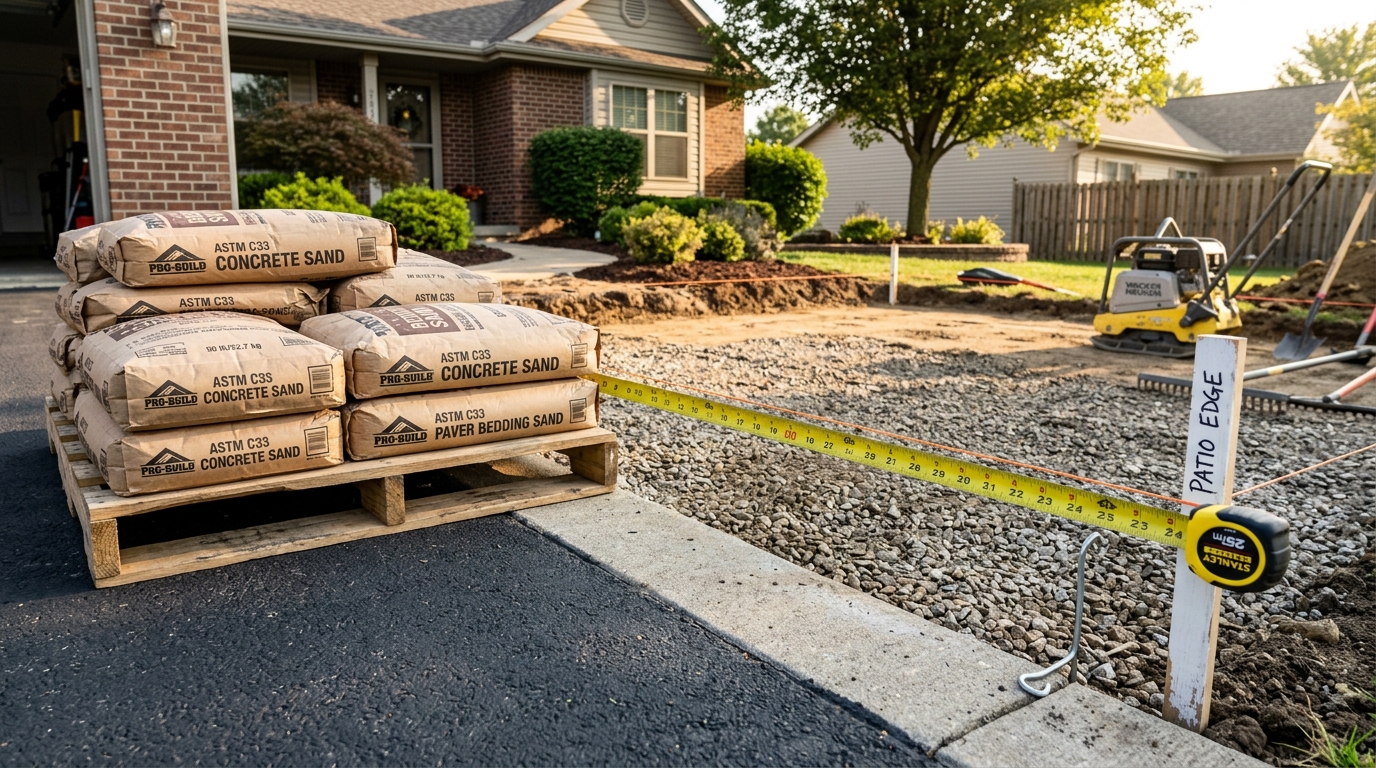
This is where I see the biggest money mistakes. Buying bags of sand for pavers from the home center feels convenient — you toss them in the truck, no delivery fee, no minimum order. But once you cross a certain threshold, bulk wins and it's not even close.
Here's how the costs typically shake out in 2024–2025:
| Factor | 50-lb Bags | Bulk (Cubic Yard) |
|---|---|---|
| Unit cost | $4–$6 per bag | $30–$50 per cu yd |
| Cost per cu yd equivalent | $216–$324 (54 bags × $4–$6) | $30–$50 + delivery |
| Delivery fee | None (self-haul) | $50–$150 flat fee typical |
| Minimum order | 1 bag | 0.5–1 cu yd usually |
| Storage | Stackable, stays dry easily | Needs tarp, takes up driveway space |
| Waste | Low — open only what you need | Moderate — you'll have some left over |
| Best for | Projects under ~0.75 cu yd | Projects over ~1 cu yd |
The break-even point lands around 0.75 to 1 cubic yard. Below that, bags of sand for pavers are usually the smarter buy. Above it, bulk saves you hundreds of dollars.
In my experience, most patio projects — anything 12×12 and up — cross into bulk territory. A 15×20 patio needs about 1 cubic yard of sand for paver base. Buying that in bags would run $216–$324. Bulk? Maybe $80–$100 delivered. That's gas money you keep in your pocket.
Not sure which side of the line you fall on? Run your numbers through the Sand Calculator — it shows both bag count and cubic yards so you can compare pricing at your local suppliers.
Don't Forget Compaction Loss
Here's a detail that trips up first-timers: loose sand takes up more space than compacted sand. When you dump sand between your screed rails and pull it flat, then set pavers on top and run a plate compactor over everything, that fluffy 1-inch layer compresses down. You lose roughly 10–15% of volume to compaction.
That's why I always calculate paver sand with a built-in buffer. If the math says 25 cubic feet, I order materials for 27.5. If it says 40 bags, I grab 44. It's not being wasteful — it's accounting for physics. Sand grains settle into gaps, vibration drives out air pockets, and what looked like a full inch before compaction might measure 7/8" after.
The compaction factor also depends on the sand type. ASTM C33 concrete sand for pavers — with its angular, well-graded particles — compacts predictably. Mason sand or play sand? Those round grains shift unpredictably. One more reason to use the right material.
What Type of Sand to Calculate For
When you calculate paver sand, make sure you're calculating for the right stuff. The ICPI (Interlocking Concrete Pavement Institute) specifies ASTM C33 coarse concrete sand as the standard bedding sand for pavers. This is paver base sand with angular particles that lock together under compaction and allow proper drainage.
You want a 1-inch depth — not 2 inches, not a half inch. One inch compacted. That's the sweet spot backed by decades of ICPI research and thousands of successful installations.
What you do not want:
- Polymeric sand — That's for filling joints between pavers, not bedding underneath them
- Mason sand — Too fine, retains water, and leads to settling
- Stone dust / screenings — Turns to cement-like paste when wet and causes pavers to heave. I wrote a whole piece on why stone dust fails under pavers if you want the gory details
- Play sand — Uniformly round grains, zero interlock, total failure as a paver base sand
Get the material right, get the math right, and you're 90% of the way to a patio that stays flat for twenty years.
Frequently Asked Questions
How many bags of sand for 100 sq ft of pavers?
At a 1-inch bedding depth, 100 sq ft needs about 8.3 cu ft of sand — roughly 17–19 fifty-pound bags after adding 10% for compaction and waste. The exact count depends on the bag brand and how tightly it's packed. Plug your dimensions into the Sand Calculator for a precise bag count.
How much sand for a 10×10 patio?
A 10×10 paver patio (100 sq ft) requires approximately 0.34 cubic yards or 19 fifty-pound bags of ASTM C33 concrete sand at a 1-inch depth, waste included. That's squarely in "buy bags" territory — no delivery fee, and you can fit them all in a pickup truck or SUV. Check the Sand Calculator for your exact numbers.
Is 1 inch of sand enough for pavers?
Yes — 1 inch is exactly what ICPI Tech Spec 2 recommends as the compacted sand for paver base thickness. Going thicker than 1.5 inches causes pavers to rock, shift, and settle unevenly over time. Going thinner than ¾ inch makes it nearly impossible to screed a flat surface. One inch hits the sweet spot between workability and long-term stability. For more on getting that layer perfectly flat, read our guide on how to level sand for pavers.
How much does a cubic yard of sand weigh?
A cubic yard of dry ASTM C33 concrete sand weighs approximately 2,600–2,800 pounds (about 1.3–1.4 tons). Wet sand can push past 3,000 lbs per yard. This matters when you're hauling — a half-ton pickup maxes out at roughly half a yard safely. Know your truck's payload rating before you load up. Use the Sand Calculator to figure out tonnage alongside volume.
Should I add extra sand for waste?
Absolutely. I add 10% minimum to every paver sand calculation. Between filling screed rail voids, topping off low spots, spillage off the edges, and compaction, you'll use more than the raw math suggests. On irregularly shaped patios or sloped jobs, I bump that to 15%. It's far cheaper to return half a bag than to make another supply run mid-project with a half-finished patio.
Compare Quotes from Licensed Landscaping Contractors
Don't want to DIY? Connect with pre-screened local trade professionals verified for active state licensing, general liability insurance, and proven customer satisfaction.
Specializing in construction cost verification, code compliance, and civil engineering benchmarks for SpanSizer.